Painting a Picture of Tov
By Kandice Elliott, student midwife. Originally published in Torah Home Magazine, Issue 1.
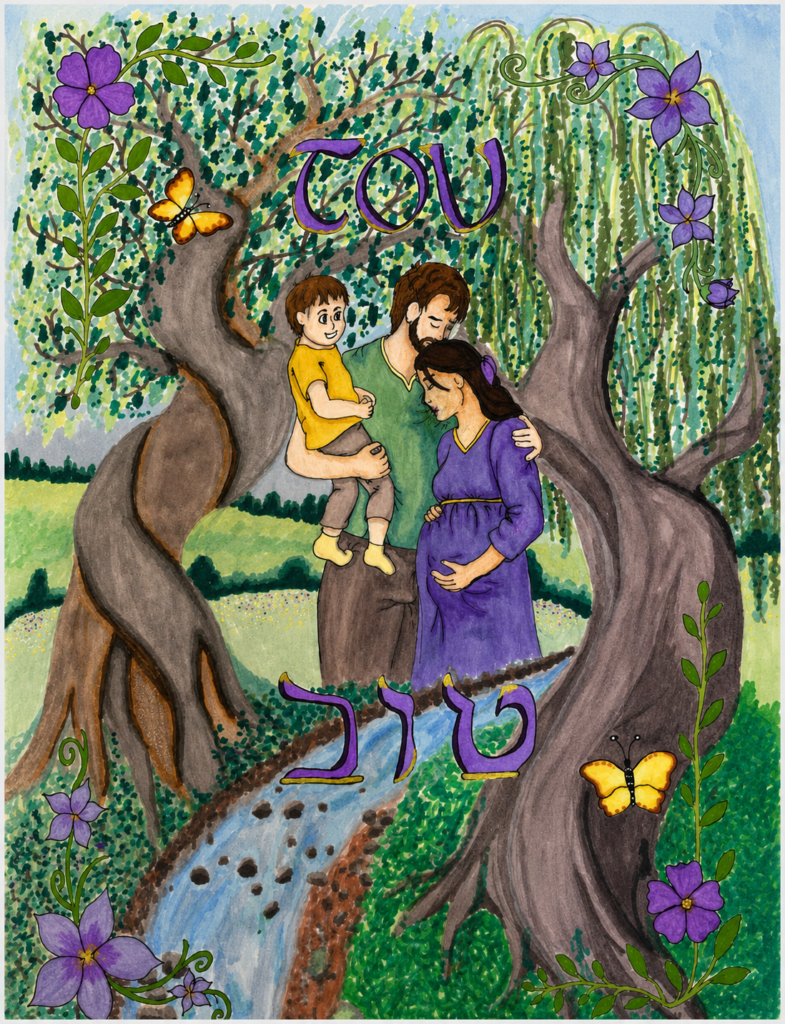
For one of my college assignments, I was asked to create a piece of birth art. Many students might immediately think of labor, delivery, or a newborn baby. Instead, I found myself thinking about something that begins long before birth itself: family.
The result was a painting centered around the Hebrew word tov (טוב), a word often translated as “good.” According to Jeff Benner’s Ancient Hebrew Lexicon, however, tov carries the idea of fulfilling the purpose or design for which something was created. That definition became the foundation for everything I included in the artwork.
The painting shows a growing family. A husband stands beside his pregnant wife while holding their young child. They are surrounded by trees, flowers, butterflies, and a flowing river. The atmosphere is meant to feel peaceful and life-giving, almost like a glimpse of paradise.
When I first began planning the project, I spent time thinking about what paradise would look like. I asked several people what came to mind when they imagined a perfect place. Many mentioned trees, rivers, and beautiful natural surroundings. I agreed. A flowing river has always seemed peaceful to me. It brings life wherever it goes.
That idea appears throughout Scripture. The Garden of Eden was watered by rivers. Psalm 1 compares a righteous person to a tree planted by rivers of water. Healthy trees grow where there is nourishment, and healthy families flourish when they receive the support they need.
That is one reason I chose to include the river in my artwork. It represents life, growth, and the kind of environment where families can thrive.
The trees were especially important to me. At first glance, they may simply look decorative, but there was a deeper reason I included them.
While planning the painting, I remembered seeing another artist use a tree as a symbol connected to pregnancy. That inspired me to think about the similarities between trees and the placenta. If you look at the branching blood vessels of a placenta, they resemble the roots and branches of a tree. Just as a tree draws nutrients from the ground and distributes them throughout the plant, the placenta carries nourishment to a growing baby.
The comparison fascinated me.
Pregnancy is often described in medical terms, but I think there is something beautiful about recognizing how many patterns YHVH has woven into His creation. The same Creator who designed trees also designed mothers, babies, and the placenta that sustains new life.
The flowers in the painting are somewhat simpler. I chose them because I enjoy that style of artwork and wanted to add my own personal touch. The butterflies also contribute to the feeling of beauty and life that I hoped to create. Together, these elements help communicate the atmosphere I wanted the painting to have.
The central focus, however, is not the scenery. It is the family.
I have become increasingly interested in maternity care and hope to work with mothers and babies in the future. As I learn more about pregnancy and birth, I have come to believe that mother-baby-family-centered care is incredibly important.
One concept that has especially influenced me is the idea that pregnancy and birth do not affect only a mother. They affect an entire family.
In many healthy families, a husband plays a vital role in supporting his wife throughout pregnancy, labor, birth, and the postpartum period. Dr. Robert Bradley emphasized this principle in Husband-Coached Childbirth, observing that mothers often rely on the support of those closest to them during labor.
That observation matches what I have seen as well. When a husband is actively involved, he is often able to provide comfort, encouragement, and reassurance in ways that no one else can. The relationship between mother, baby, and family matters.
This conviction also influenced my decision to connect the artwork to the International Childbirth Initiative’s Step 3, which encourages routine mother-baby-family maternity care.
I realize that not every family situation reflects the ideal shown in my painting. We live in a world where relationships are often broken by divorce, death, abuse, abandonment, and many other hardships. Not everyone has access to the support system they wish they had, yet I still believe there is value in presenting a positive vision.
One reason I hope to display artwork like this in my future midwifery practice is because visual images can spark meaningful conversations. A mother, father, or child might notice the painting and ask a question. That question could open a discussion about support during pregnancy, family relationships, birth preparation, or the kind of environment parents hope to create for their children.
Sometimes people need help imagining what is possible before they can begin working toward it.
The Hebrew word tov reminds us that something is good when it fulfills the purpose for which it was designed. When I think about family, pregnancy, and children, I see that principle everywhere. A husband supporting his wife. Parents caring for their children. New life growing and flourishing. These things reflect the design established by YHVH from the beginning.
My painting is ultimately an attempt to capture that vision: a picture of life, growth, family, and purpose working together in harmony.
In other words, a picture of tov.